July 21, 2026
leading through transitions
Reading time: 12 min.
by Sjoerd Luteyn
Part of Leading Through Transitions, a soul.com series listening to leaders navigating real change, one conversation at a time.

"Unfortunately, what I've seen in the different moments has been: it is easiest when there is a crisis. The crisis forces people. There's no choice but to confront some kind of change. And suddenly the minds are a lot more open."
Marc Rivers is not celebrating crisis when he says this. He is describing a pattern he has watched repeat across three decades of finance leadership, and one he now lives inside daily. Since April 2024 he is the Chief Financial Officer in the humanitarian sector, at a moment when the sector has gone through what he calls an earthquake in funding, one that has placed the sector's familiar model under examination.
Before Geneva there was a decade at Eli Lilly, twelve years at Roche, and the CFO role at Fonterra, the New Zealand dairy cooperative. Before all of that, a childhood split down the middle: born in Switzerland to a Swiss mother and an American father, raised in the United States from age five. He calls himself a bridge, a connector, a translator between ways of looking at things. It is a theme he keeps returning to, and it turns out to be more than biography. It is a method.
When I ask Marc which transitions he sees, he starts wide. Change is everywhere and accelerating, he says: technologically, socially, in perspective, on many levels at once. At 56, he has watched the pace turn exponential within a single working life. His preferred word for it is not disruption but growth. In a way, he says, it is all progress.
What interests him is less the inventory of changes than what sits underneath them. Peel back the layers, he argues, and you usually arrive at identity and perception. People and organisations resist change most fiercely when it touches their sense of who they are. And much depends on the frame we carry. See the world as a zero sum game, and every change looks like a loss to be avoided. Marc puts the alternative in his own words:
If we learn to change the mindset, to see that it's in our own individual interest, we will profit more from collaborating and from working together. We can grow the pie by doing that together, much more than trying to get a bigger share of a pie.
For Marc, the deepest transitions are not technological or economic. They are shifts in worldview, and worldview reaches down to the most fundamental questions: who am I, what is my purpose for being here.
This is also how he reads his own sector. He acknowledges that the examination the humanitarian model is going through is demanding. At the same time, he sees it as healthy. It forces a question that comfortable years allow organisations to avoid.
What actually is our purpose? What is it that the world needs us to do that is uniquely us?
In our conversation I offered Marc a frame from Hannah Arendt: authority as that which we are willing to obey while retaining our freedom, or an authentic and undisputed experience common to all. Perhaps certain crises carry that kind of authority. He recognised the pattern immediately.
The crisis asserts its authority. There's no question but to obey it, because there's no alternative.
And then, after a pause:
It releases great power. Every time.
Every organisational crisis he has led, he says, was at the root a crisis of confidence in purpose and mission. His response has become almost a ritual. Use the moment to reopen the purpose question. Debate it with everybody, so that everybody feels part of the answer. Reaffirm what the next chapter of purpose is. Only then work backward to plans and actions. At Fonterra, where the cooperative itself was at risk, the authority of the crisis was undisputed. At the ICRC it has been the same, twice over.
The harder case, he admits, was Roche. Margins were good, the pipeline was strong, and there was no obvious burning platform. It is also where our paths first crossed. At the time, soul.com accompanied Marc and his finance organisation in finding language and expression for the purpose of finance: the layers of meaning beneath the mechanical duties, something closer to ‘truth seeking’. I remember it as a moment when a situation shifted from problem into possibility. Marc remembers it as the harder kind of leadership. Without a crisis to assert its authority, the work of awakening something latent has to happen through language and patience. He takes the lesson seriously rather than comfortably.
Why should it require a crisis to question everything? Before the crisis, we should already be thinking, what's next, and how to disrupt ourselves
In the background of that period, two very different cultures were merging: Genentech's San Francisco energy and Roche's Swiss tradition. Marc, himself a blend of both worlds, found himself acting as the bridge between them. “One plus one is three”, he says of cultures meeting, and being the translator in between became a theme of his career.
There is an old precision hiding in the word itself. Crisis comes from the Greek ‘krisis’: a decision, a judgement, a turning point. Its root is the verb ‘krinein’: to separate, to choose. A crisis, in its original sense, is not something that happens to you. It is a moment that demands distinction and choice.
Read this way, Fonterra and the ICRC faced crises that arrived from outside. At Roche nothing arrived, and the choosing had to be done without one. That is exactly the question Marc still carries: how to generate a small internal crisis, so that minds open before circumstances force them to. Such moments open what policy scholars call a window of opportunity: a passage in which political and bureaucratic will turns flexible, and things become possible that were unthinkable the year before. Great things can happen in these moments, precisely because these moments have authority.
Marc describes himself as an inherently peaceful person, which made his maturing as a leader partly a story about conflict. The turning point was learning to separate destructive conflict from constructive conflict, and discovering that the difference is rarely about the content.
When I offered the observation that most conflict is relational rather than about the content of the work, his agreement was immediate: completely true. And the cost is concrete.
As long as the conflict lives in the relationship, the content cannot move. Discussions stall, processes wait, and the real question never gets onto the table. Much of it, he has found, is simply misunderstanding: communication and language.
His own remedy began as an occupational hazard. Explaining financial concepts to people outside finance, a farmer asking what an ‘impairment’ is, forcing him to drop the technical terms he was hiding behind, and to discover he had not fully understood some of them himself. Work through the misunderstanding, he says, and you usually find you were closer than you thought.
He traces part of that discovery back to the Roche years and the work on the purpose of finance.
It just frames it in a whole different language. The power of language to help change perception, to reframe things.
The rest is condition setting. Group size, setting, even how the chairs are arranged shape whether a group can grapple productively with an idea. And there is a geometry to it.
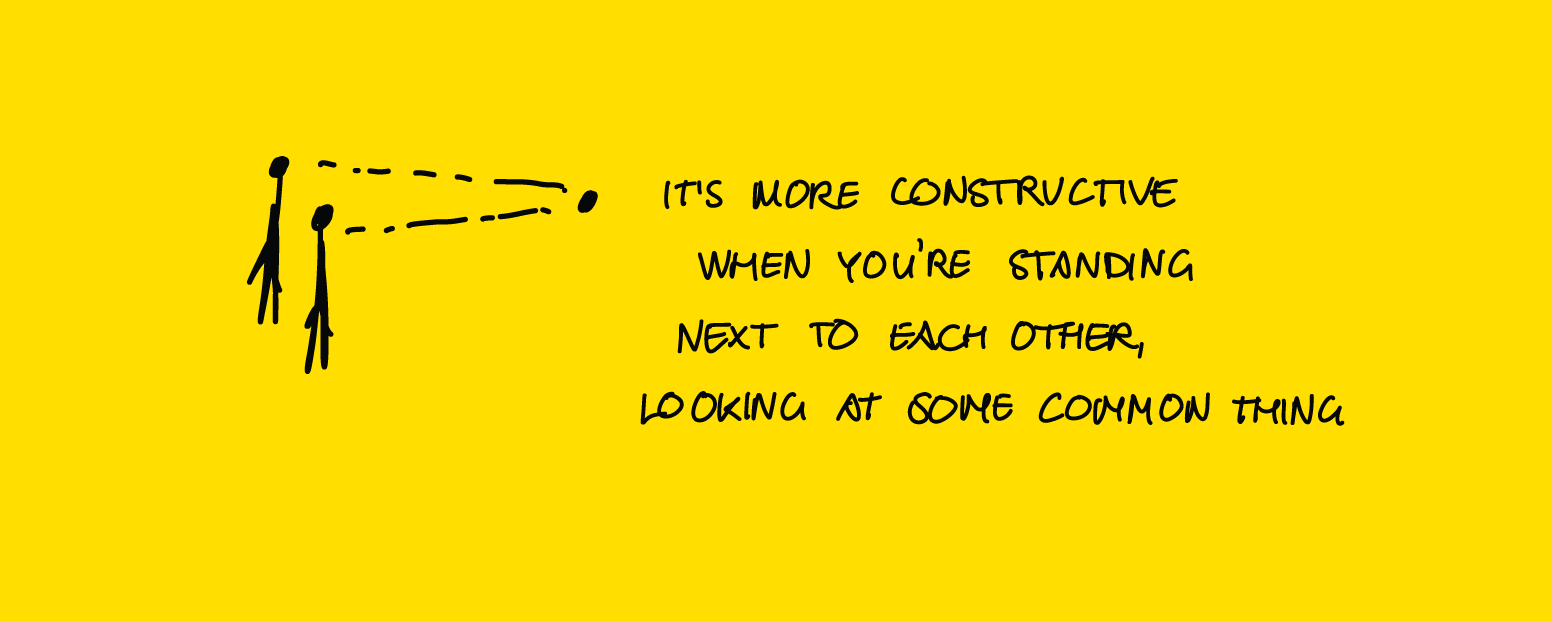
The leader's job, in his account, is to keep turning face to face confrontations into side by side ones: two people looking together at the thing they are trying to figure out.
This is where the threads of his thinking meet. A crisis carries the authority to reopen the purpose question. Purpose, once reaffirmed, becomes the common object a group can stand next to. And with that object in view, conflict shifts from relational to constructive, and content and process begin to flow again. Condition setting, he calls it, and he counts it among the leader's most important work.
Marc is direct about what sustains his own hope. His faith gives him the long perspective: the future is bright, and the open question is only how much pain and misery we pass through on the way there. But he insists the same conviction can be built with logic alone. Humanity has barely begun to tap what even partial collaboration has already achieved. He also chooses his company deliberately, surrounding himself with people who lean optimistic.
What he refuses is certainty about the route to take at these moments of crisis. Logic, intuition, feeling, inspiration are all inputs to be tested against each other. The point is never a final answer, only a hypothesis: plan, act, observe, modify. Our perception of reality is imperfect, he says, and the best we can do is get asymptotically closer. He finds that comforting rather than unsettling.
The leader's stance that follows is a pairing he comes back to several times.
To be both confident in the future, but also humble that we don't know exactly how we're going to get there.
He recognises the same set of muscles at home, raising three sons: hopeful about their potential, humble about the paths they will choose, working to hold a field of possibility and safety around them.
Looking forward, Marc names two forces. The first is agentic AI, which he sees as a dramatic break from previous waves of technology, a burning platform that will force change he does not pretend to predict. The second is a wider movement in how societies relate to globalization and to each other, a pendulum he expects to keep swinging. He stays deliberately humble about how and when. What he holds onto is the direction underneath the turbulence.
But beneath both he sees something larger.
There's this ‘perception revolution’ that we still have to go through, which is an identity revolution. We have to learn that it is one human society that we're all part of. Whether we acknowledge it or not, it already is one.
He thinks of the Artemis II astronauts looking back at the small blue planet, and of the perspective that view offers. Seen from there, the case for collaboration makes itself. And that revolution will not arrive through global agreements alone. It has to happen at every level, individual, family, neighbourhood, city, nation, and companies have a role precisely because they are groupings of human beings. An organisation that orients its people toward making the world better is creating conditions and experiences that transform individuals. Its meaning reaches beyond whatever it sells.
Which brings the conversation back to where it started. Crises will keep arriving, and each one will assert its authority. Read in the old sense of the word, each one is also a moment of choosing. The leaders who are ready are the ones who already know what question to ask when it does.