May 12, 2026
leading through transitions
Reading time: 7 min
by Sjoerd Luteyn and Tahirih Michot
Part of Leading Through Transitions, a soul.com series listening to leaders navigating real change, one conversation at a time.

"I didn't sleep on the flight. Then I spent the day with friends walking around Athens. When we arrived back at the hotel, one of them said: so what are you going to talk about Friday during your keynote? So I started to tell him and within 37 seconds, he blurted out: boring."
When Salim Afshar shared this with the room, they laughed. He let it land.
"I took that data as something to reflect on. What are the conditions that kill hope? And then I thought: why don't we talk about how to cultivate hope in the context of systems?"
He paused. Then:
"Hope is not what you feel when the future looks clear. It's what you build when it doesn't."
What he was describing was not optimism. It was a discipline. A constant posture, as he put it, of reading reality honestly and acting from that.
Salim Afshar is a surgeon, systems thinker, and founder of a global health initiative working at the intersection of AI and organisational transformation. He was one of the keynote speakers at the ebbf annual conference in Loutraki, Greece, last month.
The conference brings together leaders, practitioners, and thinkers working at the intersection of business, ethics, and social change. This year, it gathered around a question that kept returning in different forms across every session: how do you lead when the ground is moving?
We were there as part of the facilitation team, working alongside Daniel Truran and others who helped design the programme. What stayed with us was not any single session or argument but something more atmospheric: a shared quality of searching. In conversations between sessions, over meals, and late into the evenings, leaders described environments of intensifying pressure, constant information flow, and diminishing orientation. The tools available feel inadequate. The vocabulary for what is being experienced has not yet caught up with the experience itself.
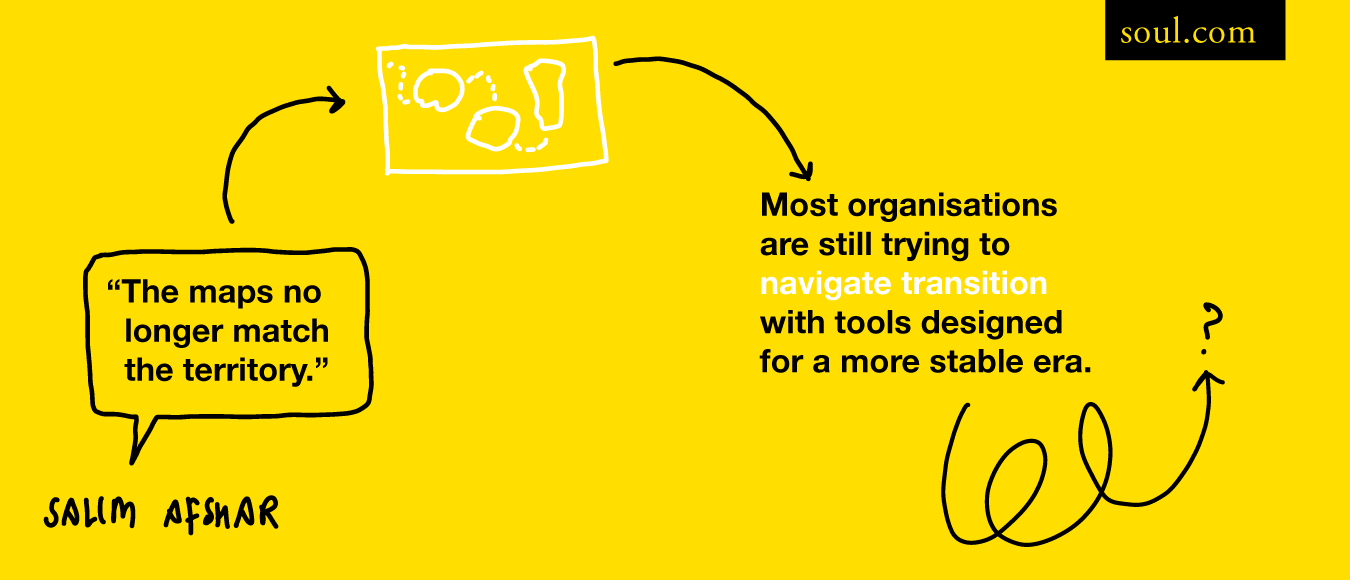
What Salim named from the stage, in the story of a jet-lagged conversation in Athens, was something many people in that room recognised but had not yet found words for. Not a crisis. Not a failure. Something quieter and more persistent: the sense that the maps no longer match the territory, and that the management vocabularies most of us were trained in were built for a more stable era than the one we are now inside.
Uncertainty itself, it turned out, was not the deepest difficulty. The deeper difficulty was knowing what matters within it.
We have spent twenty-five years working at the intersection of organisational transformation and community development. One thing we have learned, consistently, is that transitions are not project-management problems. A transition, in the sense that researchers at the Dutch Research Institute for Transitions have defined it, is a process of fundamental and irreversible change in a society's culture, structures, and practices. It takes decades to fully materialise. It cannot be steered from a single control room. It touches everything, because everything has to do with everything.
And critically: organisations are not in a transition. They are part of one.
That distinction matters more than it might first appear. An organisation that understands itself as being in a transition tends to manage it: contain it, complete it, return to stability. An organisation that understands itself as part of a transition asks a different question: what is our role in something larger than ourselves? What does this moment ask of us?
Most of the leaders we meet are being asked to navigate exactly this using tools designed for a more predictable era: business management, change management, agile frameworks. These tools are not wrong. But they were not built for conditions in which the ground itself is moving. The result is a quiet exhaustion: leaders working harder and harder, sensing that something more fundamental is being demanded of them, and not yet finding the language for it.
Salim called it an orientation problem. Not a technology problem. Not a strategy problem. The issue is what you believe, and whether those beliefs have ever actually been examined. "The most dangerous assumption," he said, "is the one that no one talks about. Because it just becomes the truth."
That is the question this series begins from.
We are working from a hypothesis. It has two parts, and they depend on each other.
The first is that an organisation that leads through a transition, rather than being carried by it, has a clear and lived sense of its own soul: its purpose in this particular moment, the values it chooses to embody even when that is costly, and the principles that guide it when short-term and long-term are in tension. An organisation that knows its soul has something to lead from. One that does not, however competent or well-resourced, tends to be moved by the transition rather than to move with it.
The second is that soul alone is not enough. The form of organisation matters as much as its direction. An organisation that intends to lead through transitions needs to organise itself according to the principles of a community rather than the logic of a product-driven enterprise: with distributed leadership, emergent strategy, and a centre of gravity in the people and their shared purpose rather than in the offering itself.
Soul without community, risks becoming a beautifully articulated purpose the organisation cannot actually live, because its form does not allow it. Community without soul risks becoming a warm but directionless collective, unable to make hard choices in the middle of a transition. Together, we believe, they form the conditions for leading through rather than being led by.
We hold this lightly. It is a proposition to test, not a thesis to defend. That is precisely why we are starting this series.
Over the coming months, we will conduct in-depth conversations with leaders navigating through real transitions in their organisations and sectors. Each conversation is structured around three questions: how do you read the reality you are in? What choices have you made, and what do those choices cost? And what do you sense may be becoming possible, even if you cannot yet fully name it?
Some of these conversations will become articles. Others will contribute to a broader synthesis. Together, they form what we are thinking of as a structured listening project: not a study, not a report, but an attempt to contribute to the kind of collective sense-making that resilient organisations depend on.
We are not neutral observers. We come to this work with a particular orientation, and it is honest to name it. We believe transformation is primarily cultural and relational before it is structural or technical. We believe organisations shape society not only through what they produce, but through the relational patterns they embody. And we believe, this is perhaps our deepest conviction, that when people experience themselves as agents of change in relationship with others, something becomes possible that is not possible alone.
That conviction is what this series is built on. Not as an answer. As an orientation from which to listen.
We begin here, with the question Salim brought back from a walk in Athens.
Not: how do we manage the uncertainty?
But: how do we build, together, the capacity to act well within it?
That is the discipline. Not hope as a feeling. Hope as something built, carefully, together.