June 24, 2026
leading through transitions
Reading time: 8 min.
by Sjoerd Luteyn
Part of Leading Through Transitions, a soul.com series listening to leaders navigating real change, one conversation at a time.
"Let me start by showing you something."
Before a single question about energy or strategy, Dirk Koelewijn turns his phone toward us. On the screen is his granddaughter, Leonora, three months old.
"This characterises me. Everyone kept telling me beforehand how special it would be, and I'd always agree, with a slight hmm, yes, sure. But this is a dimension you can only understand once it happens to you. It cannot be put into words."
Then, almost in the same breath, he makes the move that turns out to contain the whole conversation.
"I mention it because the same thing happens in organisations. With targets, with goals, with purposes. There are dimensions, frequencies, shared ambitions that also cannot be named in words. And that is exactly what makes them so hard. Hard to pass on, hard to teach, hard to learn."
A newborn cannot yet disguise anything. The masks come later. For now there is only what is real. That word, real, returns throughout the whole hour. It is the key to how Dirk understands leadership:
What happens on the outside of an organisation is the expression of something happening on the inside.
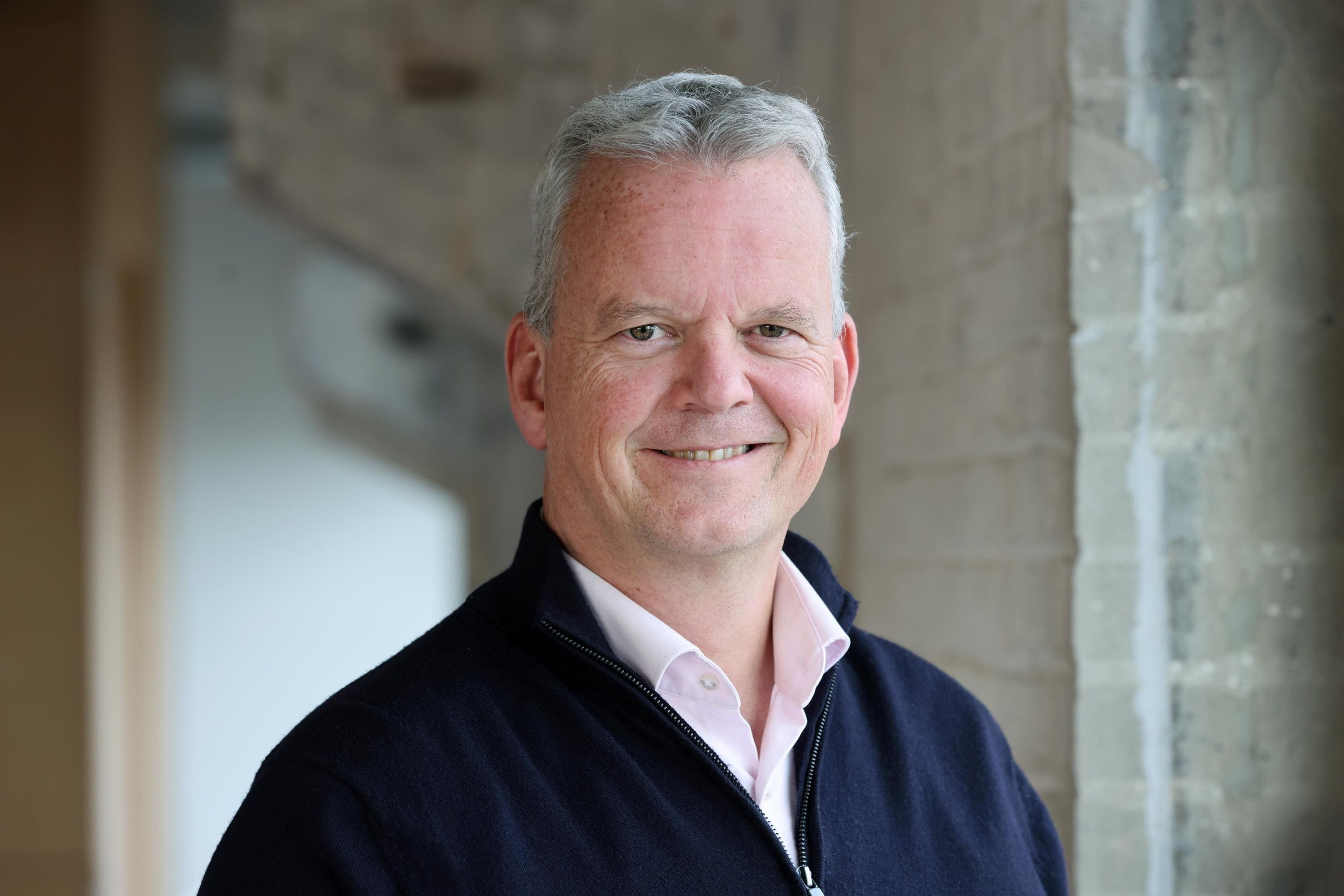
Dirk Koelewijn, fifty-four years old, is the interim director of NieuweStroom Group, a Dutch business energy and solution supplier. Before this, he was a serial entrepreneur and founder of businesses in the energy sector, with companies such as Powerhouse and ServiceHouse behind him, a period leading the energy business of the electronic retailer Coolblue, and three years of emergency and relief work in Africa and Asia in between. He is trained and skilled as a chartered accountant, yet he talks more readily about authenticity than about the clean numbers.
His central conviction is easy to state and hard to live. The visible work of leadership, the strategy, the restructuring, the hiring and the letting go, is the outward face of an inward process. The outer work is the inner work. And he means it at two levels at once: the inner work of the leader, and the inner work of the organisation itself.
Most leaders, in his experience, want to skip the second. The trouble arrives, the numbers turn, the pressure builds, and the instinct is to (re)act. Dirk's instinct is to stop and ask a different question first.
When an organisation moves into pain, he does not treat the pain as the problem. He treats it as a symptom.
"Why do marriages break? (Why do) organisations break? Because the transition was not made, or was made too late."
This is the heart of it. The world is moving through deep transitions, in energy, in technology, in the way value is created. Those transitions generate a need to change. Pain is what appears when an organisation has not answered that need in time. So the first task of a leader is not to (re)act, but to read reality.
"Transition is not making a plan and ticking it off. It is understanding where you come from."
The sharpest form of that reading is not "where are we now," but a harder question: why did we not respond when we still could have? What in our habits, our culture, our structures, our assumptions kept us from moving while there was opportunity and need to move? The question is uncomfortable, because the answer is usually internal. It points at the organisation's own patterns rather than at the market. This is the organisation's inner work, and it is the work most firms and management teams avoid.
Only once that is understood, Dirk argues, can you see clearly enough to find the few places where action will truly move things, the leverage points where an immediate transformation can begin.
He did this at Nieuwestroom before changing anything, spending his early months tracing how the company had arrived where it was, talking with its founders and its smaller and majority shareholders. He found a business that had been carried through a hard stretch as much by fortune as by design, and understanding how that had come about was what told him where to push. That diagnosis became the foundation for the strategic and operational changes that followed.
Some of the leverage was plain enough. The outward shift, away from technology and toward relationships, standing alongside customers in their problems and needs rather than selling them energy, was almost self-evident, and was already surfacing on its own.
But the leverage that mattered most was quieter, and it was internal. The relationships around the company had grown strained, and the collaboration between its various stakeholders had begun to work against itself rather than together. Repairing that, patiently and largely out of sight, was the deeper point of leverage. It is work that rarely appears in any plan. These are the dimensions Dirk pointed to at the very start, holding up the photograph: the things that cannot be put into words, captured in a single judgement, or settled with one neat solution. They are the first to be overlooked, and, once again, they are where an organisation does its inner work.
He is clear that this reading can never stop.
"Leadership can no longer rest on its laurels."
The transitions keep coming, so reading reality is not a phase you complete. It is a posture you hold.
Understanding, on its own, does not necessarily lead to results. This is the part that surprises people who expect a reflective leader to be a ‘soft’ one. Once Dirk has read reality and found the leverage, he acts with unusual firmness. A decision, for him, is closer to an incision. You cut, and not everyone likes it.
"Sometimes you have to row with the oars you have."
He will change a team, or a director, when the phase of the organisation changes. He lets people go when the commitment is no longer there. He holds his own role only a year at a time, free to stop the moment it no longer fits. What he is balancing as he makes those cuts is never a single interest, but his share of many at once: the family, the employees, the shareholders, the customers, the suppliers, the wider environment, the generations still to come. The firmness is real, and he does not apologise for it.
But, and this is what ties the conversation together, the firmness is not sourced in ego. It is sourced in the inner work. He knows this because he has felt the alternative in his own body. After selling one of his entrepreneurial endeavours, Powerhouse, he fought his way into a senior corporate board seat out of pride, and won it.
"I gave in to the temptation of pride. And then I felt, in my whole body, that it was wrong."
He fell ill, recognised he was in the wrong place, and cut the role within a month, walking away with nothing. The first incision he learned to make was on himself, and it gave him the capacity he now trusts most.
"I can literally feel a wrong choice, being in the wrong place. And I can feel it in others too."
He does not arrive at that feeling entirely alone. The mirror he trusts most to reflect back the truth he would rather not see is his wife, Erika.
"Erika is always a challenging voice of truth for me. On the things that matter, just sincere reflection."
That is why his firmness does not harden into coldness. He invests in people, sees their potential and names it, and even as he lets some of them go he can say, without contradiction:
“I can care deeply about these people. Otherwise you wouldn't do it."
So the loop closes, and re-opens. The inner work lets Dirk read reality. Reading reality reveals why the organisation did not change, and where it now can. Firmness turns that insight into decisions that cut. And then, because leadership can no longer settle into a comfortable seat and stay there, he turns inward again. He keeps that loop alive in himself quite literally.
"Every year I try to give myself an uncomfortable gift."
One year of body-oriented work, another systemic work, then psychotherapy, then relationship therapy. He treats his own development as the infrastructure of his leadership, not as something apart from it. And he believes, plainly, that the transition he keeps making in himself is the same shape as the one organisations need to make.
Perhaps this is what gives Dirk's convictions their weight. There is a Dutch saying: “never ask something of another that you are not willing to do yourself” ("vraag nooit iets van een ander wat je zelf niet bereid bent te doen" ). He asks organisations to look honestly at what is no longer working, to recognise what has been avoided, to act where action is needed, and then to begin again. It is work he has first demanded of himself.
The conversation began as an exploration of leadership in the energy sector. Yet what remained afterwards was the image of a three-month-old granddaughter Leonora who cannot yet pretend to be anything other than who she is. Perhaps that is the discipline Dirk keeps returning to: noticing what is real before rushing to change it, and having the courage to respond to what you find. Only then can real transformation become possible.
A question to reflect on:
If transition reveals what no longer fits, what is your organisation beginning to see about itself now?