June 14, 2026
leading through transitions
Reading time: 7 min.
by Tahirih Michot and Sjoerd Luteyn
Part of Leading Through Transitions, a soul.com series listening to leaders navigating real change, one conversation at a time.
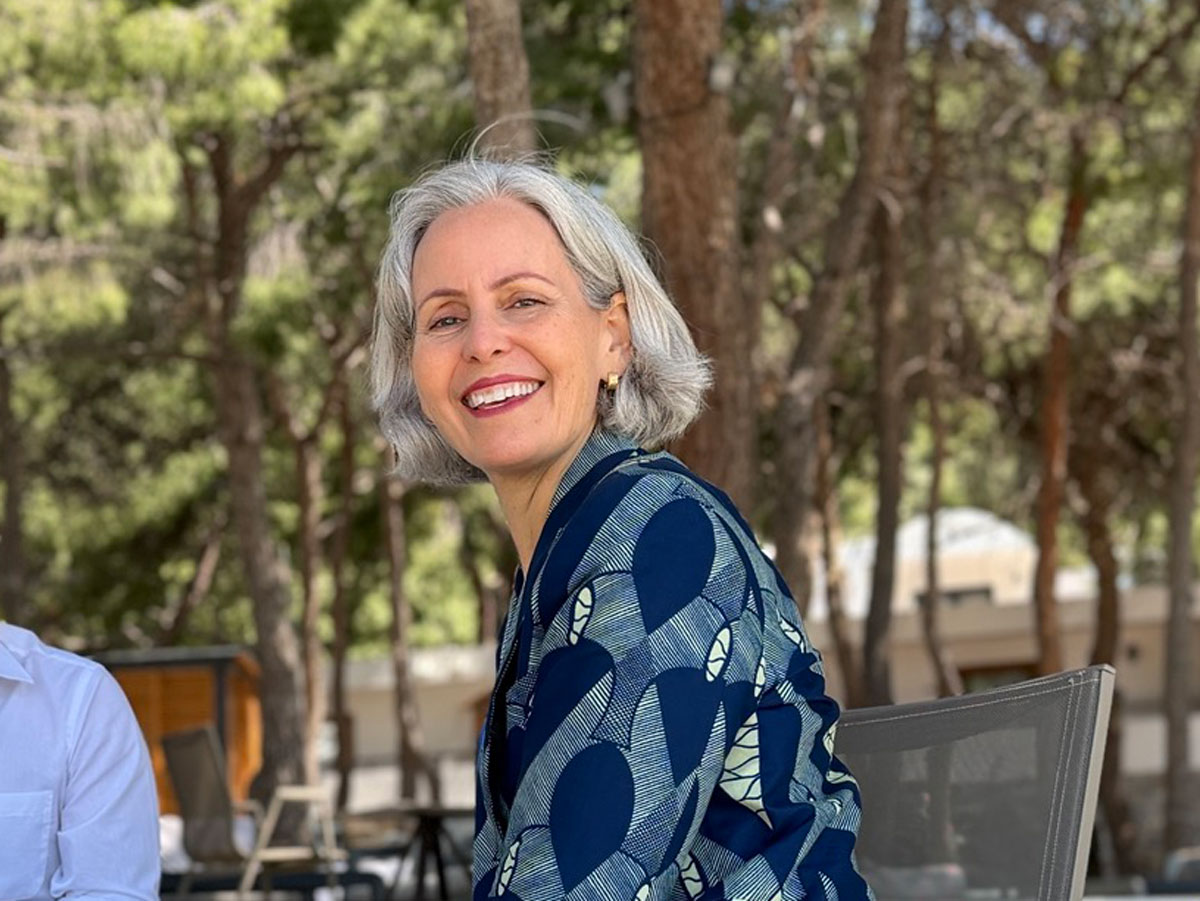
“Transition is when you have a plan and you're going about that plan and something shifts,” she says. “Sometimes those transitions can be intentional and well-planned. And sometimes those transitions happen without any warning.”
“For Haiti, operating in precarious conditions is just part of our norm. We have weather issues, earthquakes, outbreaks of disease, socio-political troubles, foreign intervention and so on. It's always been precarious. So I don't know what it means not to be in transition.”
She pauses.
“But today we're talking about something more global. And that's what feels new.”
She is speaking to us from her home outside Kigali, Rwanda, where a heavy rainstorm has just arrived. Tahirih is in Cape Town, South Africa, a cold front moving in from the sea. Sjoerd is in Zierikzee in the Netherlands, at the beginning of a summer heat wave. The following week, Alice will travel to Haiti before returning again to Rwanda, hoping afterwards for a rare stretch of staying in one place.
These days, a conversation among three people in three countries feels almost ordinary. But as the conversation unfolds, it becomes clear that many of the conditions this kind of work depends on - open movement, stable systems, frictionless global connection - may themselves be starting to shift.
Alice Nkunzimana is the founder and CEO of Papyrus International, a management and development firm she started in Haiti nearly two decades ago. Today, Papyrus works across Haiti and sub-saharan Africa in fund management, development project management, and what she calls institutional accompaniment: helping organisations strengthen their own capabilities rather than doing the work for them.
Much of her professional life has been spent building in places others describe as fragile, unstable, or difficult to operate in. For Haiti, uncertainty has never been an interruption to normality. It has been part of the environment itself. Perhaps because of that, Alice has developed a different relationship to transition.
That observation sits at the heart of our conversation.
For much of the world, instability has often been treated as a temporary interruption to normality. Something to manage until systems settle down again. Alice's experience suggests something different. Transition may no longer be the exception. It is becoming the condition. And if that is true, then the question is not how organisations return to stability, but how they build the capacity to navigate continuous change.
The answer that emerges throughout our conversation is surprisingly consistent. When people are trusted with reality and shared power to make decisions, the conversation changes.
At one point, Alice describes sitting with the possibility of laying off sixty people. USAID funding had collapsed. Several programmes faced an uncertain future. Nobody knew what would survive or for how long. Many organisations would have handled the situation through confidential executive meetings.
Papyrus chose a different path.
“We organised a town hall,”
Alice says.
“We explained to everybody that this might be happening. And what do they think? What are some of their solutions? What should we do?”
She pauses before continuing.
“We actually asked the people who ultimately ended up getting fired how they wanted to get fired.”
The sentence lands heavily. What she is describing is not a performative exercise in participation. It is something much harder: refusing to treat people as objects of decisions being made elsewhere.
Staff proposed alternatives to immediate redundancies. They suggested furloughs. They negotiated around healthcare and pensions. They identified options leadership could take back to donors. The uncertainty did not disappear. But something shifted. When people were trusted with reality and decision making power, the conversation changed.
Instead of fear, there was problem-solving.
Instead of speculation, there was agency.
At the same time, shareholders faced their own difficult decision. Papyrus had spent years building reserves. The company had intentionally limited dividend extraction and maintained a strategic investment fund designed for future growth.
Alice proposed using it to keep people employed.
“We're prepared to burn that down to zero if necessary,” she recalls saying. “And then close.”
Not everyone agreed immediately. But for Alice, the alternative raised a deeper question.
“What are we saying? Are we saying the last nineteen years was a lie?”
This part of the conversation reveals something important. Trust is not a cultural aspiration hanging on the wall. It is something tested when values become expensive. The ability to respond this way did not appear during the crisis. It had been built years earlier.
Three years before the funding shock, Papyrus was facing a different challenge. The organisation was growing quickly. Quality was beginning to slip. Decisions were accumulating at the top. The company was becoming increasingly dependent on a small number of leaders carrying a growing amount of complexity. Alice could see the strain.
Her response was not to tighten control.
It was to distribute it.
Papyrus reorganised around the Entrepreneurial Operating System (EOS). Strategic and operational leadership were separated. Decision-making moved into a shared leadership structure. Organisational priorities, performance metrics, and financial realities became visible across the company.
“It used to be me,” Alice says. “I was the CEO and I had the C-suite working under me and I made the decisions. What this did was shift that into a group of five.”
Then she laughs.
“I was not happy, at first.”
The discomfort was real. She had built the company. She knew it in ways nobody else did. Handing over authority felt risky. Yet over time, something unexpected happened. The organisation became stronger because leadership was no longer carrying everything alone.
“People can log on and see where I'm at. Am I doing the things I said I would do? What are my numbers? Am I doing my job? And I can look at anybody else.”
One of the surprising things in the conversation is that Papyrus did not become more participatory by becoming less structured. It became more participatory by becoming more disciplined. The systems matter here. The rhythms. The visibility. The shared accountability. The operational clarity. Trust, in this case, was not built through looseness. It was built through consistency and transparency over time.
When people were trusted with reality, they became more capable of carrying responsibility, not less.
About halfway through our conversation, Alice introduces a phrase that stops us.
“The decision-making world.”
We ask her what she means.
“Decisions about what is mined, who gets to sell it, where it is transformed, where the value added is made. Decisions about what Africa or Haiti needs, what donors want to give. And those decisions are being made by people who have never lived what they are deciding about.”
There is no anger in her voice. Only observation. She describes how consultation often happens after priorities have already been set. How decisions cascade from distant institutions, donors, and regulatory systems disconnected from the realities they affect.
“Consultation is not possible when the person demanding it is not one of them.”
Then she widens the frame.
“I think that happens also to small communities in the United States. In the Netherlands. In South Africa. It can happen on a micro or a macro level.”
What Papyrus was learning internally, Alice increasingly sees playing out globally. The same tension appears again and again: a widening distance between where decisions are made and where consequences are felt. And increasingly, people are challenging that arrangement.
She points to changing negotiations around mineral extraction across Africa. Agreements that once delivered a small share of value to countries are being renegotiated. Governments are demanding a larger role in shaping how value is created and distributed.
“The transition wave is coming whether or not people build dams.”
What is striking is that Alice speaks about these shifts not only with concern, but also with excitement.
“I feel like this is a great time to be alive.”
At one point she jokes:
“You can be a McKinsey consultant in your living room now.”
The comment is playful, but the observation is serious. Knowledge is becoming more accessible. Expertise is becoming more distributed. The monopoly over who gets to participate in problem-solving is weakening. The same redistribution of intelligence Papyrus had to develop internally may now be unfolding across institutions, economies, and societies.
Late in the conversation, Alice casually mentions that she studied fine art. Her specialisation was metalwork. Her Master’s thesis, she says with a smile, was on spoons. For years, people questioned whether she belonged in rooms of finance, development, and strategy. Whether someone without an MBA could build a multinational organisation.
“I don't know where we would be trying to eat soup without a spoon, to be honest.”
The joke lands because it points toward something deeper. The challenges Papyrus faced were never solved by technical expertise alone. They required relational intelligence.
Trust.
The ability to create coherence across differences.
The ability to stay open when circumstances encourage people to close down.
“I know how to squeeze all the brain cells out of my team, and I know how to respect them and give them space.”
Perhaps that is the leadership practice this entire conversation keeps circling around. Not leadership as control. Not leadership as having all the answers.
Leadership as creating the conditions where intelligence can become collective.
Toward the end of our conversation, Alice returns to something she is thinking about increasingly: mobility. For decades, many organisations have operated with a simple assumption. If expertise is needed somewhere, someone can travel there.
But disease outbreaks, climate disruptions, geopolitical tensions, fuel insecurity, and conflict are making movement less predictable. For organisations working across multiple countries, these are no longer abstract risks. They are operational realities.
“We're looking hard now at who we have in different places and how we can get them up to speed on some of the things that we would normally be doing if we were travelling.”
The implication is significant. Local capability is no longer simply a development principle. It is becoming a strategic necessity. The organisations best prepared for a world of constraints will not be those that can move expertise around most efficiently. They will be those that have already invested in intelligence, trust, and capability embedded within the places where they work.
Seen this way, the transition Papyrus has been making internally is not separate from the wider transitions Alice sees unfolding globally. It is preparation for them. Transition, in Alice's world, was never something that happened between periods of stability. It was the condition itself. Listening to her, we began to wonder whether the same may increasingly be true for the rest of us.
For much of the world, uncertainty has often been treated as something temporary - something to manage until things settle down again. But what if that assumption is beginning to change?
If transition is becoming less of an interruption and more a feature of the environment we are learning to live within, what capacities are we being invited to develop now?