May 26, 2026
leading through transitions
Reading time: 12 min.
by Sjoerd Luteyn and Tahirih Michot
Part of Leading Through Transitions, a soul.com series listening to leaders navigating real change, one conversation at a time.

"Life itself is a transition."
Kafele Boothe said it almost as a given, early in the conversation, before we had even fully framed our questions.
"When people talk about transition, what they really mean is a departure from the trajectory they originally envisioned."
He paused, then added:
"And I think comfortability is an enemy to resilience."
Two sentences in, and the frame had already shifted. We had come expecting to talk about organisational strategy, AI, the future of the creative industry. What we got instead was something harder to categorise: a reading of reality, from someone who has spent years inside the mechanics of how organisations actually function under pressure, and who has stopped pretending otherwise.
Who he is and where he works
Kafele Boothe currently runs finance for North America at Design Bridge and Partners, a global brand design agency within the WPP network, one of the largest advertising and communications holding companies in the world. Some of their clients include Unilever, Colgate-Palmolive, and Mastercard. His career has also included senior finance roles across the Omnicom network, Hearst, and time as an investment analyst at the Bahá'í World Centre in Haifa. He has also served on the board of directors of UN Women New York as their Finance Chair.
He is based in New York, in an industry that operates at what he described, without drama, as the sharpest edge of shareholder capitalism. Creative agencies, holding companies, a labour market where people move every two or three years and loyalty has always been thin.
In the opening article of this series, Salim Afshar described hope not as something you feel when the future is clear, but as something you build when it is not. Kafele builds from a different starting point. He builds from structural honesty.
His understanding of transition begins with expectation, not change itself. Change, he argued, is not the problem. People expect change. What creates pain, in organisations and in individuals, is the gap between what they assumed would continue and what is actually unfolding. The wider that gap, the harder the impact.
And the organisations most exposed to that gap, in his view, are precisely those that trained themselves most thoroughly to expect continuity.
"People who are in more comfortable lived environments are not so resilient. And the reason why people in war-torn countries can look resilient to others is because they never assumed a constant. Their life is moulded by vicissitudes, by adjustment to trajectory. So as big shocks happen, it's not as much of a departure."
This is not, for him, a theoretical observation. He sees it play out in practice inside large organisations every time financial pressure intensifies.
The pattern he describes is worth following carefully, because it is not simply a critique. It is a loop.
When organisations come under shareholder pressure, they reach for the lever that is easiest to pull. Not because leaders are careless, but because the system is structured that way. In service organisations, the largest controllable cost is staff. So the response to financial stress, almost reflexively, becomes reductions in force. Restructuring. Layoffs.
"Money in is a lot more difficult to impact than money out. So when companies are in certain financial straits, the quickest way to profitability is to reduce the money out. And in service organisations, the biggest money out is staff."
He noted, with the precision of someone who has lived inside these decisions, that in the United States, publicly traded companies are not simply culturally inclined toward shareholder value. They are legally obligated to act in shareholders' financial interests. The incentive structure is not incidental. It is constitutive.
What he has observed, watching this from close range, is what happens after the cuts. People stop investing fully in the mission. They enter what he called a holding pattern, waiting to see which direction the wind will blow. Initiative softens. Enthusiasm withdraws.
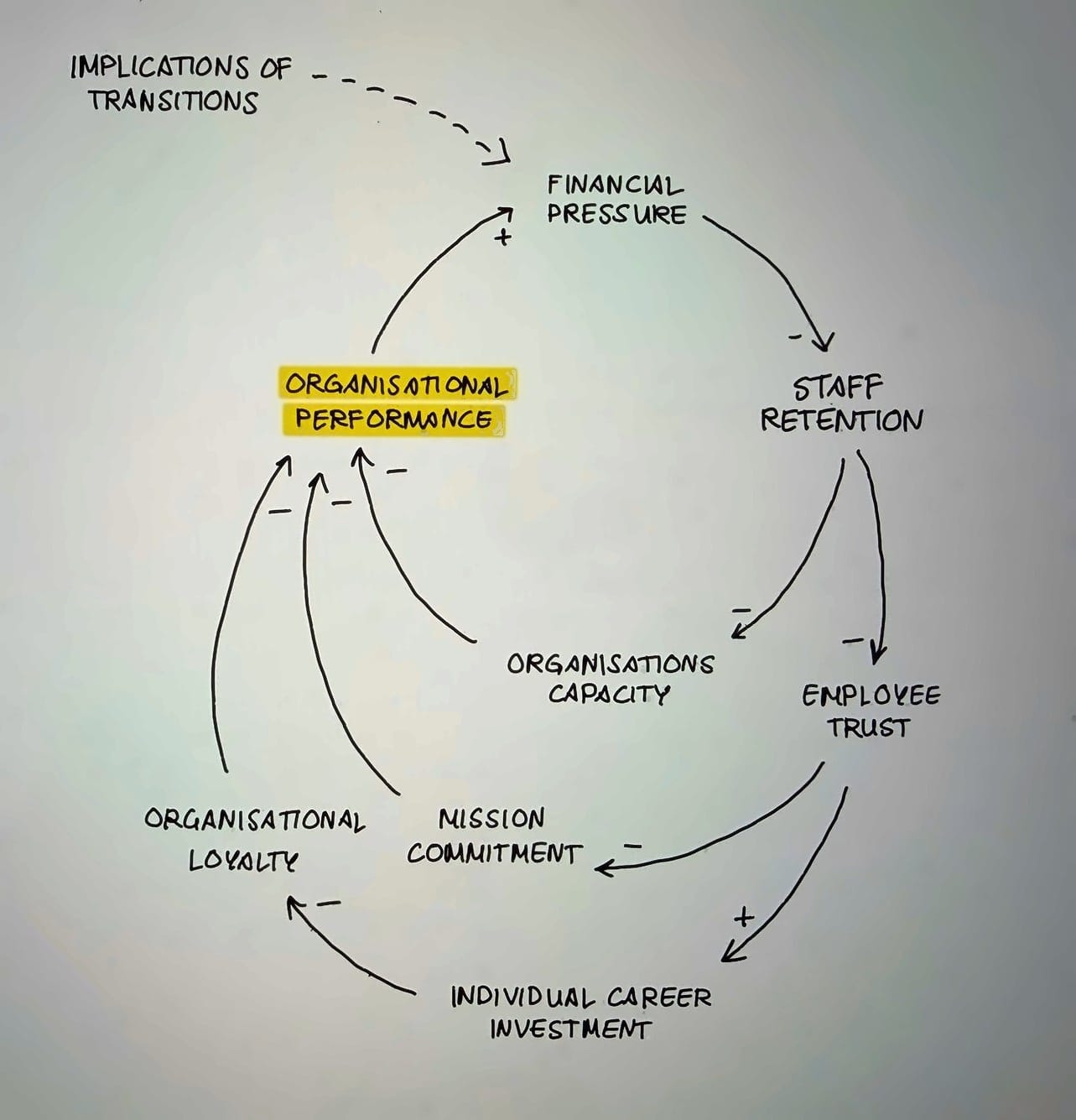
And here is where the loop becomes visible: organisations under stress cut people to survive financially. But cutting people hollows out the investment in purpose that made the organisation worth surviving. The response that was meant to stabilise the organisation quietly destabilises it from the inside.
There is a further turn. As people sense that the loyalty contract no longer runs in both directions, they redirect their energy. Toward their own development. Their own mobility. Their own futures. The organisation's stress response, in other words, accelerates the very detachment it was trying to prevent.
What disturbs Kafele most is not the logic of the system. It is the language draped over it.
"When organisations say they care about people, you need to ask: who are the people they're talking about? Because if you say people first and then lay off ten percent of the workforce, you're not talking about those people. They're a labour cost. All the while, executive compensation continues to climb."
He is careful not to reduce this to individual moral failure. Leaders, in his view, are often themselves operating under constraints they did not design. But the performative language of care, layered over structurally unchanged incentive systems, erodes trust in a way that cuts deeper than the difficulty itself. Not the hardship. The pretence around it.
This is something he has chosen, deliberately, to do differently in his own work.
He meets with employees across the company, from junior creatives to account directors, and does something most finance leaders do not. He teaches them how the system actually works. How organisations make decisions under pressure. What shareholder logic means in practice. Why hard work and merit, while genuinely valuable, do not guarantee security in the way people assume.
"People think that hard work and merit equals financial security. That's not how the world works. I'm going to show you how it actually does."
He describes his relationship to the people in his organisation in terms that are striking for someone in his role.
"I look at everyone as a potential person who will start their own agency, or who will be in a senior leadership team at some point. I want you to see me as a financial partner. That means helping you understand how organisations actually make decisions, what drives restructuring, what shareholder logic looks like from the inside. The mental models that run these systems. Because there is only so far you can go without understanding those things. A company is a stepping stone. What I care about is you as an individual.”
There was no bitterness in the statement. It came from clarity. His loyalty runs to people rather than to institutions, not because he is disillusioned, but because he has read the situation accurately and chosen the most honest form of stewardship still available within it.
In New York's creative industry, this is not idealism. It is realism adapted to a specific environment, one in which everyone, to some degree, already knows the rules.
Kafele referenced an established idea from psychology: the region beta paradox, coined by Harvard professor Daniel Gilbert. It describes how people endure tolerable discomfort far longer than truly unbearable situations; because mild suffering does not trigger the mechanisms that force change. When things become genuinely unbearable, people take action. When things are merely difficult, they adapt and stay.
He applied it without quite announcing it as a verdict.
Many organisations today may be operating inside precisely that zone: not healthy enough to inspire real trust or commitment, not broken enough to force genuine transformation. People continue. The organisation functions. But something essential has already quietly withdrawn.
What remains, in his account, is individual capacity. The person who has developed enough financial literacy to read the situation clearly. The person who has not attached their sense of security to an institution that cannot guarantee it. The person who, as he put it, hopes for the best and expects the worst, not from cynicism, but from a trained readiness for change.
Near the end, almost casually, he referred to a concept from the Baha’i faith: that the erosion of institutions, the collapse of assumed norms, the thinning of trust between people and systems are not only signs of breakdown. They are also signs of transition and organic disintegration.
It highlighted that not everything that is disintegrating is meant to survive in its current form.
The task ahead, as he described it, is neither denial nor acceleration. Not clinging to collapsing structures, and not celebrating their collapse either. But learning how to build, quietly and deliberately, inside the fracture itself something more constructive, stronger and meaningful.
Perhaps the question to ponder is:
When institutions can no longer be relied on in the ways we once assumed, what capacities do people need to build to reclaim their agency and shape the futures emerging through the fracture?