August 13, 2026
leading through transitions
15 min.
by Mahmud Samandari
Part of Leading Through Transitions, a soul.com series listening to leaders navigating real change, one conversation at a time.
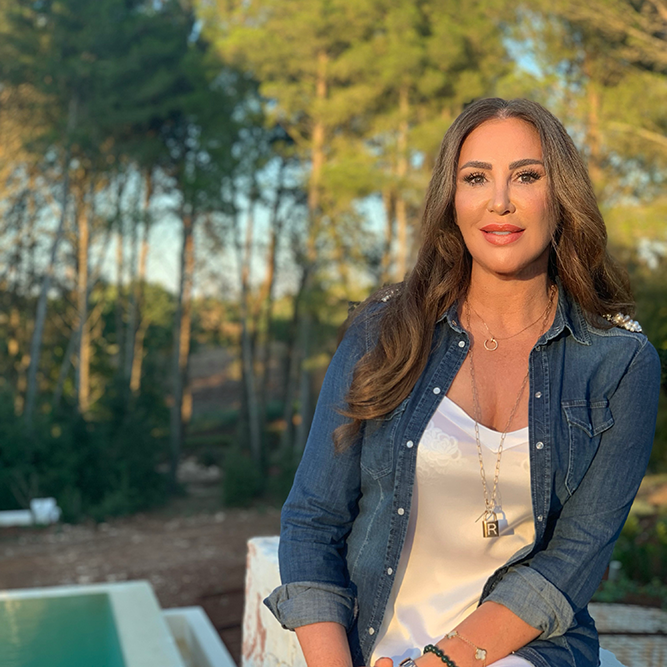
"Nothing could have happened if I hadn't transformed myself first."
It is not the answer you expect from someone who has spent much of her professional life helping build institutions designed to shape economies.
Roberta Calarese has worked at the intersection of law, finance and governance for more than two decades. Today she is the founder and CEO of GHAYA and co-founder of GHAYA Advisory, where she works with organisations, governments and business leaders seeking to create long-term value that extends beyond financial performance alone. She has helped shape the Dubai International Financial Centre during one of the region's most significant periods of economic development, has had an executive leadership role in a large conglomerate, among others.
Yet when asked about transition, she returns not to institutions, markets or strategy, but to herself. Nothing she is building today, she says, would have been possible without first undergoing a profound personal transformation.
As our conversation unfolded, it became clear that this was more than a personal reflection. It was also her explanation for why so many organisational transformations struggle to take root. The external work, she believes, can only go as far as the internal work of the people leading it.
We are speaking with Roberta Calarese from Dubai.
Over the course of her career, she has helped build systems designed to support transformation at scale. Her work has involved creating legal and regulatory frameworks, advising business leaders and governments, and helping organisations navigate periods of profound economic and institutional change. Few people have spent so much time thinking about how systems evolve and what allows them to endure.
What struck us most, however, was not the breadth of her experience. It was the lens through which she now interprets it. Again and again, the conversation returned to the same observation.
Organisations do not transform simply because strategies improve, structures change or new frameworks are introduced. They transform when the people leading them begin to see differently. That insight was not the starting point of her career. It was its consequence.
For years she believed, like many leaders, that transformation was primarily an organisational challenge. Build the right structures. Design the right governance. Introduce the right processes. Align people behind a shared vision. Experience gradually taught her otherwise.
Again and again she watched organisations invest enormous energy in change while remaining fundamentally the same. Eventually she realised that the real obstacle was rarely a lack of strategy or capability. More often, it lay in the assumptions leaders continued to carry about themselves, about leadership and about the organisations they were trying to change. Long before organisations transform, something has to shift in the people leading them. That conviction now shapes everything she does.
Much of Roberta's professional life has been spent helping build systems capable of responding to profound change.
When Dubai set out to establish an international financial centre, the challenge was not simply to create another institution. It was to create an entirely new legal and regulatory environment capable of attracting global investment and supporting the country's long-term economic diversification. It required people to imagine possibilities that did not yet exist and then build the conditions that would allow them to emerge.
Today she sees another transition unfolding.
The financial systems developed over previous decades are giving way to new possibilities: decentralised finance, tokenisation, new forms of ownership and broader access to investment. Institutions are changing, but so too are the assumptions on which they have been built.
For Roberta, finance has never been simply about money. It is one of the primary enablers of transition.
"Finance is a key enabler of any transition. Whatever you want to change, it needs funding at the bottom of it. Where the money goes is what actually brings the transition to life."
Yet even this, she believes, is only part of the story. The deeper question is not whether financial systems are evolving, but whether the people designing and leading those systems are evolving as well.
One experience has remained with Roberta throughout her career.
Over an extended period, an organisation she led invested heavily in cultural transformation. Leading consultants were engaged. New frameworks were introduced. New language appeared throughout the organisation. Considerable time, energy and resources were devoted to changing the culture.
Yet, despite the effort, very little fundamentally changed.
Looking back, Roberta does not believe the failure lay in the quality of the strategy. Nor does she question the sincerity of the people involved. Instead, she sees a gap between the transformation the organisation hoped to achieve and the transformation its leaders were willing to embody.
"It doesn't matter what consultants you bring in, what great plans you write or what cultural initiatives you launch. If the leaders do not become deep role models of the change, it is bound to fail."
Organisations, she suggests, develop their own habits, assumptions and ways of working over many years. These gradually become embedded in the culture. They shape how people make decisions, what they pay attention to, how they respond to uncertainty and even what they imagine to be possible.
Changing that organisational DNA requires far more than introducing new processes or adopting new language.
It requires leaders who themselves have changed.
For Roberta, this insight became impossible to ignore. If organisations consistently reproduced the thinking of the people leading them, perhaps the real question was not how organisations change, but how leaders themselves learn to see differently.
That question would eventually lead her somewhere she had not expected.
The transition behind the transition
The answer did not come through another leadership programme or another organisational framework. It came through her own life.
Years ago, dissatisfied both professionally and personally, Roberta began an intensive period of inner work. Guided initially by a psychologist whose practice combined psychology with contemplative traditions, she explored meditation, breathing practices, Buddhism and a range of approaches that invited her to observe herself with greater honesty than she ever had before.
She does not describe this period as self-improvement.
She describes it as undoing.
"I had incredible secretaries for twenty-five years. Then I had to become my own secretary. That was a journey of humility. Unlearning and relearning everything by myself."
There is humour in the story, but underneath it sits something far less comfortable: the quiet disorientation of no longer knowing, for a while, who she was without the role. For many years, success had been accompanied by increasing responsibility, influence and external recognition. Like many senior leaders, her professional identity had gradually become intertwined with achievement. Leadership meant having answers. Being capable. Solving increasingly complex problems. Remaining composed when others looked for certainty.
Without consciously choosing it, those assumptions had become the lens through which she understood herself and the world around her. Letting go of them was not a single decision but a slow, often uncertain unlearning, a willingness to sit with not knowing, in a life that had rewarded her for always knowing.
What began to change was not simply her behaviour. It was the lens itself.
"Seeing differently was not about acquiring new knowledge; it was about questioning the lens through which I had viewed my entire life," she explains. "I had spent decades believing that value came from achievement, responsibility and the ability to solve problems."
The questions that surfaced during this period were not abstract. Where did she derive her sense of value? Why had achievement become so closely connected with identity? What did leadership look like once certainty was no longer the goal? What happens when control gives way to curiosity? They were questions she had to live inside of, not simply answer.
"What I gradually discovered was that many of the qualities we most admire in leaders - wisdom, trust, empathy, creativity and courage - emerge not from control but from self-awareness. The more I understood myself, the more I realised that sustainable transformation, whether personal or organisational, begins with consciousness. We cannot create a different future while operating from the same beliefs, fears and patterns that created the present."
That insight fundamentally changed how she leads, how she makes decisions and even how she defines success. Leadership became less about directing change and more about creating the conditions in which change becomes possible; a shift not only in what she did, but in how she related to herself, to the people around her and to uncertainty itself. Looking back now, she sees a direct relationship between that inner journey and everything she has built since.
"Everything that I have birthed in the outer world is actually stemming from my own inner transformation."
In many ways, GHAYA is the outward expression of that journey: a direct continuation of the inner shift she describes, rather than a separate professional chapter. It did not emerge simply as a new business venture. It emerged from a different understanding of leadership, value and transformation.
Today, Roberta works with organisations, governments and business leaders seeking to create forms of value that extend beyond financial performance alone. Economic success remains essential, but it is no longer sufficient as the sole measure of progress.
The deeper question is what kind of future organisations help bring into being. How do they create long-term prosperity while strengthening people, communities and the ecosystems of which they are part?
For Roberta, this is not a departure from business. It is an evolution of how business understands its purpose. Purpose is therefore not something added to strategy. It shapes strategy from within. That conviction influences decisions about governance, investment, partnerships and leadership. It also creates tension.
Purpose-led organisations continue to operate within competitive markets. Attractive opportunities appear that promise growth while pulling the organisation away from the reason it exists.
"The tempting opportunities show up. That's the trade-off. You have to stay true to it, even when it slows you down."
Those moments reveal whether purpose is genuine or merely aspirational. The same applies to leadership itself. Trust grows less from eloquent communication than from consistency between intention and action.
"You walk the talk. You're honest, transparent and inclusive. You listen. And you genuinely care about the people you lead."
For Roberta, these are not simply leadership behaviours. They are the natural consequence of seeing the world differently.
One of the most striking moments in our conversation came when we returned to the organisation whose transformation had, by many measures, fallen short.
Had those seven years been wasted? Roberta does not think so. Many of the people involved eventually left the organisation. But they carried something with them. Not a new organisational structure. Not another change programme.
A different way of seeing. The questions they had begun asking. The assumptions they had started to challenge. The practices they had slowly embodied. The seeds planted during that period continued growing elsewhere, shaping new teams, new organisations and new communities. What appeared unsuccessful at the organisational level became quietly transformative in individual lives.
"We always say that if we can transform just ten percent of the top leadership, that is enough."
Listening to Roberta, we found ourselves wondering whether transitions spread differently from how we often imagine. Not primarily through successful change programmes or redesigned organisations. But through people who carry new ways of seeing into every system they help to build. Perhaps that is why lasting organisational transformation cannot begin with strategy alone. Strategy shapes what organisations do. Consciousness shapes what organisations become.
If organisations cannot become what their leaders themselves have not yet become, perhaps one of the greatest responsibilities of leadership during times of transition is not simply to lead change.
Perhaps it is to continue transforming the way we ourselves see.
If that is true, what kind of inner work does leadership now require?